Nearly every organization now uses AI. About seven percent have scaled it. The technology isn't what's missing.
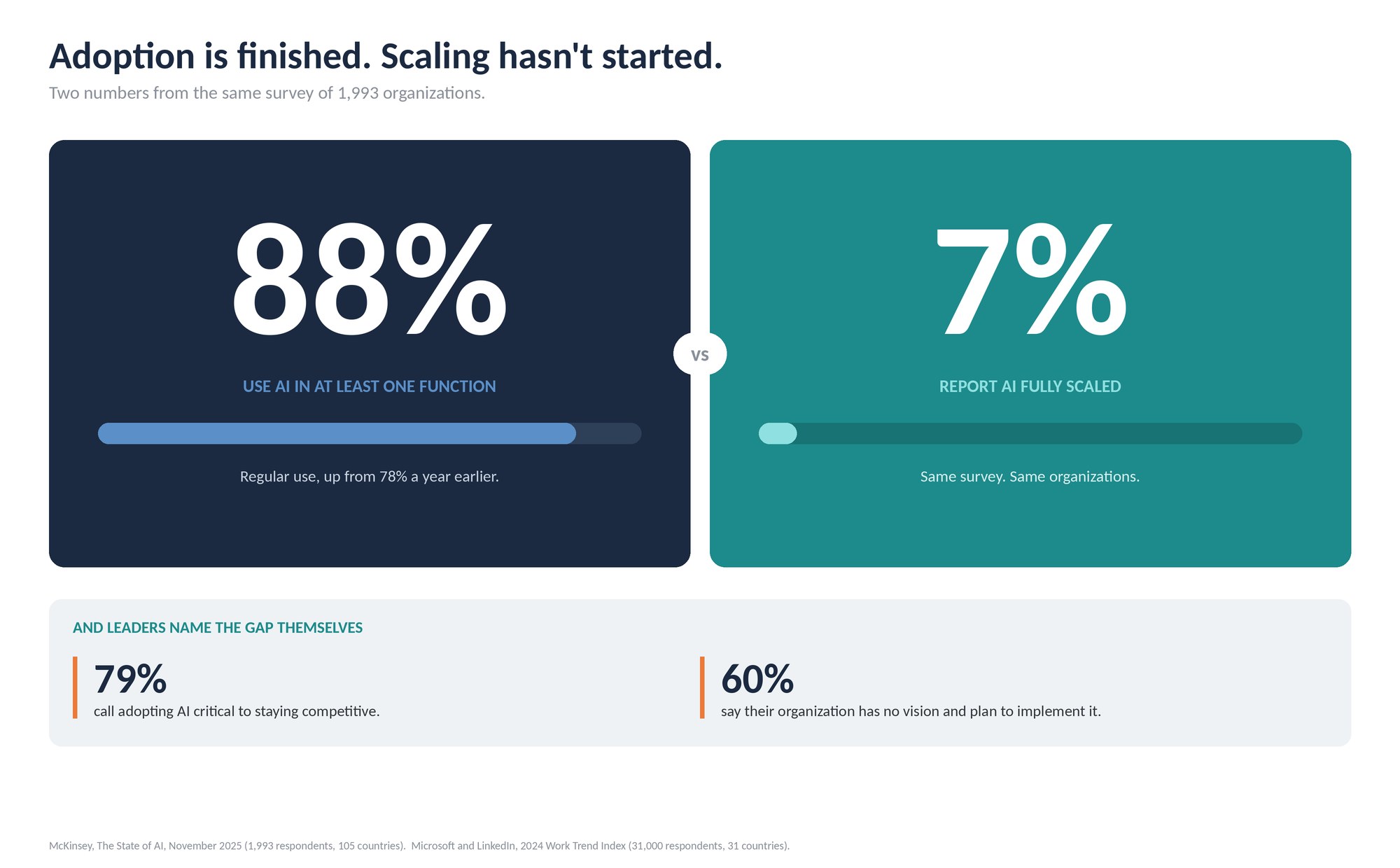
Adoption is finished. Turns out 88% of organizations now report regular AI use in at least one business function, up from 78% a year earlier. That's McKinsey's November survey, 1,993 respondents across 105 countries1. In the same survey, 7% said AI is fully scaled across the organization.
The tools work. So the question worth asking is what the other 93% ran into.
AI is an accelerant. Point it at a process that works and you get more of what works. Point it at a process that never quite worked and you get more of that, faster.
Leaders already know this. In fact, 79% agree adopting AI is critical to staying competitive, and 60% say their organization lacks the vision and plan to implement it. That's the 2024 Work Trend Index from Microsoft and LinkedIn, 31,000 respondents across 31 countries2. Leaders are naming the gap themselves, and it sits in the design of the work rather than in the software.
Consider an account plan. A rep drafts one with AI in twenty minutes and it reads well. Three colleagues then spend most of two hours each working out which parts are accurate. Research from BetterUp Labs and Stanford, published in Harvard Business Review, found 41% of workers had received AI-generated work that looked finished but lacked substance, at a cost of close to two hours of rework each time3. The plan got faster. The work got slower.
That pattern reaches well past one thin document. An unclear handoff becomes an unclear handoff at volume. Approvals nobody could explain get made sooner. Forecast calls that ran on optimism still run on optimism.
| Rollout Thinking | Activation Thinking |
|---|---|
| Buy the tool, then look for the use case | Name the broken step, then ask what it needs |
| Measure licenses activated | Measure workflows redesigned |
| Train everyone on the features | Let the team doing the work redesign the work |
| Pilot, evaluate, scale | Small bets, public learning, adoption follows the wins |
| Success is usage | Success is a step that no longer exists |
Pick one workflow AI is already running. Trace it end to end the way it worked before AI touched it. Then ask the team one question: which step here exists because somebody, sometime, decided it should? That step is the work. The tool was never going to find it for you.
Adoption was the easy part. The teams pulling ahead don't have more AI. They fixed the process first, then pointed the tool at it.
Up Next: The Five Things To Define Before You Buy
Tracing one workflow shows you where the friction sits. It won't tell you what to settle before the next tool arrives.
Most teams buy first and define later. Five decisions tend to go unmade, and each one comes back as a problem after the contract is signed: who owns the workflow, what number it's meant to move, what managers coach toward, what's allowed and reviewed, and what counts as working. Any AI tool will run without these five. It just runs into whatever is already there.
Read the Next Post →Sources
Numbered citations throughout this article draw on the sources above.
