Most AI purchases work exactly as promised. Buying was never the hard part. Deciding is.
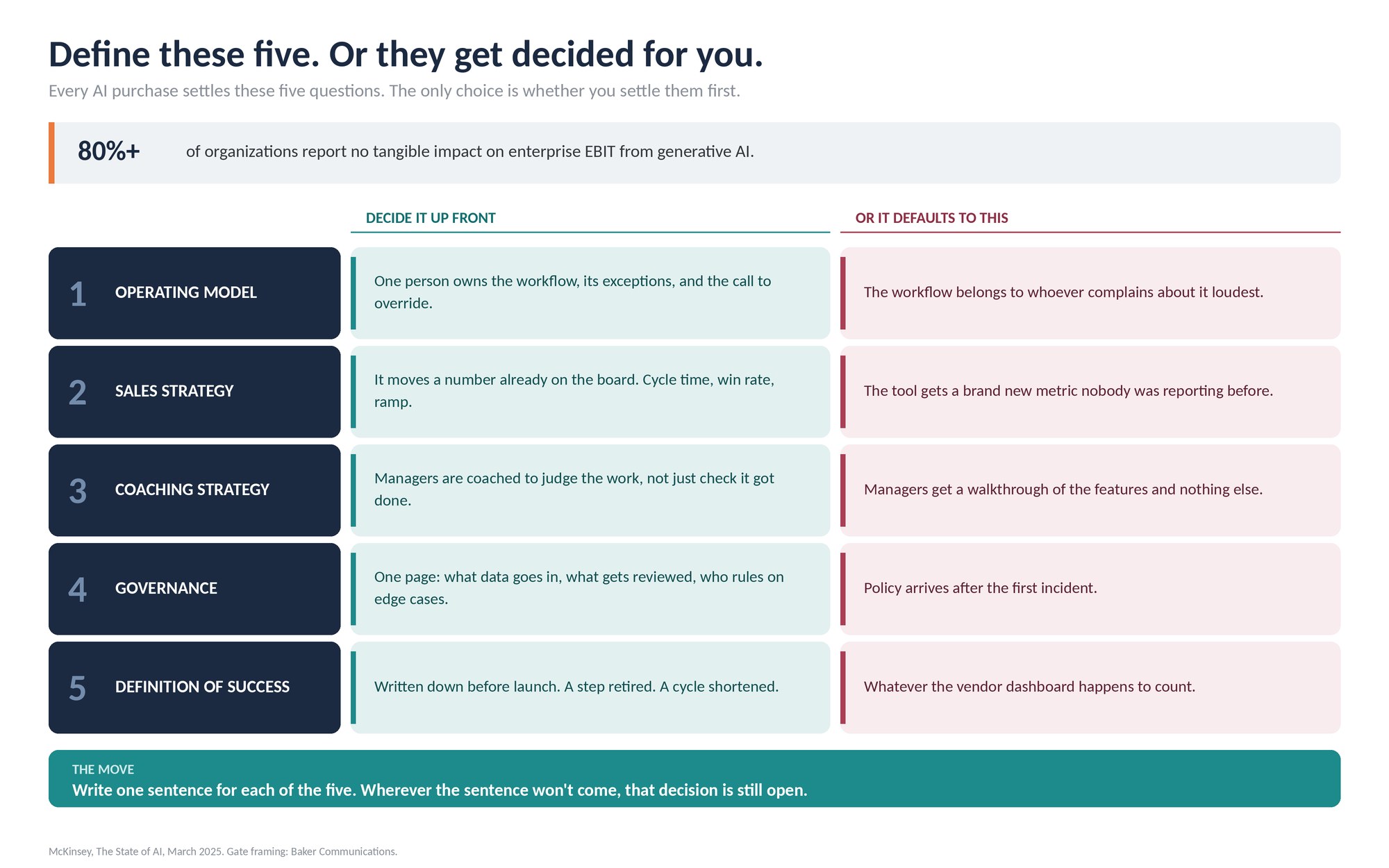
More than 80% of respondents told McKinsey their organizations aren't seeing a tangible impact on enterprise-level EBIT from generative AI. That's the State of AI survey published in March 20251. That isn't a story about tools failing. The tools mostly do what the demo showed.
Five decisions sit underneath that number. Each one gets made either on purpose before the purchase, or by default afterward. None of them require a vendor.
Governance is the clearest example, because it's already being decided without anyone deciding. Of the knowledge workers using AI at work, 78% brought their own tool. And 52% of people using AI at work are reluctant to admit using it for their most important tasks. That's the 2024 Work Trend Index from Microsoft and LinkedIn, 31,000 respondents across 31 countries2.
So the rules are getting written by whoever downloaded something last week. Nobody involved is doing anything wrong. They moved faster than the policy, which is what capable teams do when the policy isn't there yet.
The other four decisions work the same way. If nobody names an owner, the workflow ends up with whoever complains about it most. If nobody defines success, success becomes whatever the vendor's dashboard happens to count. The decision always gets made. Left alone, it gets made by accident, and by someone who wasn't trying to make it.
Who owns this workflow once AI is inside it?
Before AI, ownership was obvious because the work sat with a person. Put a tool in the middle and the seams move, but somebody still has to own the output, the exceptions, and the decision about when to override. Name that person before launch and the tool has a home. Skip it and the workflow belongs to nobody. Nobody is who reviews it when the output starts drifting, and nobody is who answers when a customer asks why.
Which number already on the board is this meant to move?
Not a new metric invented for the tool, but a number leadership already reports and already cares about, whether that's cycle time, win rate, ramp time or coverage. If a tool can't be tied to one of those in a sentence, the case for it hasn't been made yet. That's a useful thing to learn before the money moves rather than after.
What do managers do differently on Monday, and who teaches them?
This gate gets skipped more than the other four, and it decides more than the other four. When AI handles more of the drafting, the manager's job shifts toward judgment: was this the right call, not was this done. That's a different conversation and most managers haven't been taught to have it. In fact, 63% of employers name the skills gap as the key barrier to business transformation, according to the World Economic Forum's Future of Jobs report, drawing on over 1,000 companies3. Deciding who develops the managers is part of buying the tool.
What's allowed, what gets reviewed, and who decides?
Three questions on one page: which data can go in, which outputs need a human before they leave the building, and who rules on the edge cases. Teams don't need a legal treatment. They need to know where the lines are so they can work without checking over their shoulder. Clear rules speed people up.
What counts as working, agreed before launch?
Write it down before the tool goes in, because afterward the definition drifts toward whatever the data happens to show. Licenses activated is the easy number and the wrong one. A better one names the change you'd accept as proof: a step retired, a cycle shortened, a review that stopped being necessary.
| Bought First | Defined First |
|---|---|
| Ownership sorts itself out later | One name owns the workflow at launch |
| The tool gets its own new metric | The tool moves a number already on the board |
| Managers get a features walkthrough | Managers get coached on judgment calls |
| Policy arrives after the incident | One page says what's allowed and who decides |
| Success becomes whatever the dashboard shows | Success was written down before launch |
Start with an AI tool your team already uses, not the one you're thinking about buying. Open a blank page and write five headings down the left side: owner, metric, coaching, rules, success. Give each one a single sentence.
A real answer on the metric line reads like this: this is meant to cut proposal turnaround from six days to three. An answer that isn't really an answer reads like this: this will make the team more efficient. The first one can be checked in ninety days. The second one can't be checked at all.
Wherever the sentence won't come, or comes out vague, that gate is still open. Most teams find two or three open. Finding them on a tool you already own costs nothing, and it shows you exactly what to settle before the next purchase.
If you can only settle one of the five this quarter, settle the definition of success.
It's the gate that drags the other four along with it. Write down what working actually looks like, say a review step retired or a cycle cut from six days to three, and the rest stops being optional. You can't claim that result without naming who owns it. You can't track it without picking the number it shows up in. You have to decide what managers coach toward to get it, and you have to say which outputs get checked before they reach a customer.
One clear definition of success pulls the other four decisions out of you. Start there, on a tool you already own.
Up Next: What AI Costs After The License
These five gates are decisions. Decisions are cheap. The next cost isn't.
Every AI tool arrives with a second bill that rarely appears in the business case. Somebody has to learn the tool, run the experiments that go nowhere, and check the output that looked finished and wasn't. In most teams the same handful of strongest performers absorb it, because they're the ones who notice when something is wrong. The next post puts numbers on that second bill.
Read the Next Post →Sources
Numbered citations throughout this article draw on the sources above.
