Most people give AI one sentence and expect it to fill in the rest. Then the output comes back generic, and the tool gets blamed for it.
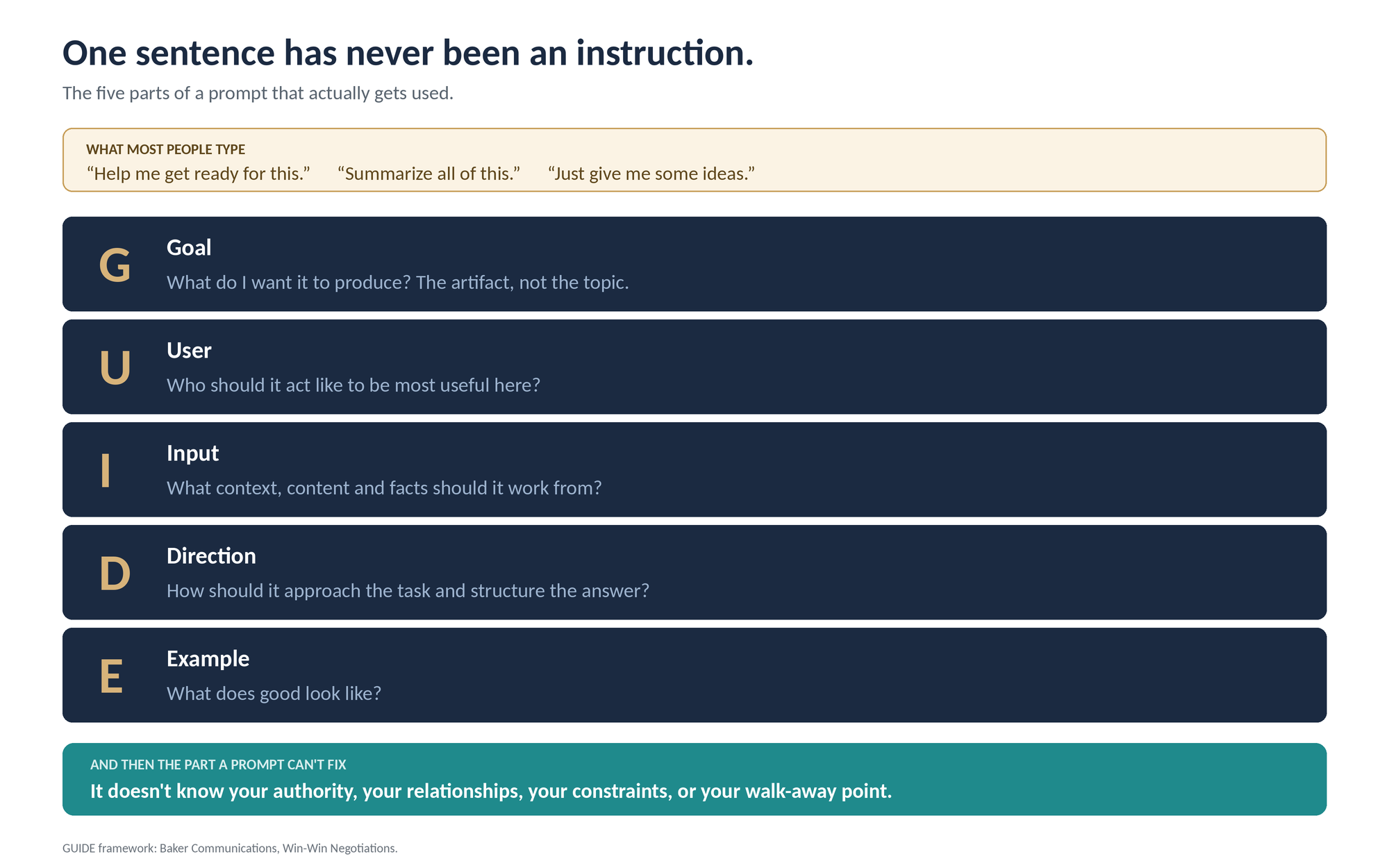
Here are the three most common prompts in business. Help me get ready for this. Summarize all of this. Just give me some ideas.
Nothing wrong with any of them as a thought. As instructions, they leave out everything the tool needed to be useful. No stated outcome, no idea who it should be behaving like, no context, no constraints on length or tone, and no sense of what a good answer would even look like. Then the output arrives sounding reasonable and saying nothing, and people decide AI isn't much help for real work.
It's usually the prompt.
Because the gap between a weak prompt and a good one isn't a small quality difference. It's the difference between something you throw away and something you actually use, and the cost of the weak version isn't zero. Somebody still spent twenty minutes reading it, deciding it was thin, and doing the work themselves.
The other reason is that the fix is learnable in about ten minutes. This isn't a skill gap that needs a curriculum. It needs a checklist, which is what we built.
| Most People Type | What Actually Works |
|---|---|
| Help me get ready for this | State the outcome you want |
| Summarize all of this | Tell it what role to play |
| Just give me some ideas | Give it the full context |
| (nothing about length or tone) | Set the limits, the tone, and the format |
| (nothing about quality) | Show it an example of good |
We teach it as GUIDE because the order matters and because five things are easier to remember with a word attached.
Weak version, and this is close to verbatim from what most people actually type:
“Help me prepare for my renewal meeting.”
GUIDE version:
Same subject, same tool, same thirty seconds of typing. The second one comes back as something you'd take into the room.
Three adjustments cover most of it, and they're worth knowing because the instinct is to rewrite the whole prompt when a nudge would do.
| If It Feels | Say | Why It Works |
|---|---|---|
| Generic | Focus on uncovering trade-offs. Organize this into three themes. Limit it to the five most important points. | Specific asks produce specific answers |
| Wrong in tone | Make this sound collaborative rather than confrontational. Rewrite it more directly. Soften it for an early conversation. | Tone matters as much as content in a real conversation |
| Too decided | Give me two ways to phrase this. Show me a conservative and a more assertive version. What are three questions I could ask next? | You want options to choose from, not a verdict |
A good prompt gets you a better draft. It does not make the output true.
AI can sound completely confident while being wrong or incomplete, and confidence is the thing people mistake for accuracy. Treat what comes back as a starting point, and separate what you actually know from what you're assuming.
There are also four things it will never know, and they happen to be the four that decide most outcomes. It doesn't know your authority. It doesn't know the relationship. It doesn't know your organization's real constraints. And it has no idea what your actual walk-away point is.
Which leads to the reframe that changes how people use it. An unknown isn't a problem. It's a question for the conversation.
That's worth sitting with, because it inverts the usual reaction. When the draft has a gap, most people either fill it with a guess or go back to the tool. The gap is more useful than either. It's your agenda for the meeting.
Take the last prompt you typed into AI and look at which of the five you left out. Most people find they gave it a goal and nothing else.
Then rewrite one prompt properly, for something real you have this week. It takes about two minutes longer and you'll know inside one attempt whether it was worth it.
Keep the good ones. A prompt that worked is reusable, and most people throw them away.
The tool is rarely the problem and neither is the person. It's that nobody was ever taught what a complete instruction looks like, and one sentence has never been one.
Goal, user, input, direction, example. Then check it, because sounding right and being right are different things, and only one of them is your job.
The Whole Series in One Place
Across twelve pieces the argument has been one thing said several ways: AI isn't a rollout to manage, it's a movement to activate, and the work that decides whether it pays off is design work rather than software work.
The Activation Playbook pulls it together into a thirty day arc with nine specific moves and the five conditions that decide whether any of it holds. It's the same material, organized for someone who has to actually run it.
Explore the AI Activation Playbook →