Joe DiDonato l Chief of Staff
You finally made it past the first round of tough sales interviews, and you’re now sitting across from the big dotcom boss. You thought this was going to be a rubber-stamp meeting, but s/he has only one question: “What’s your 100-day plan to fix our Sales?” Gulp…
Okay. Not to worry. Here’s a starting point for you to help you formulate your thoughts. It has only 7 steps, so it’s not overwhelming. But from our experience, it works.
Step 1: Implement a Sales Management System. What’s a Sales Management System you ask? This is like the “back office” for sales. It’s how you ensure consistency, and equally importantly, predictability. Think of it like an accounting back end that is made up of the usual suspects: accounts payables; accounts receivable; payroll; general ledger and those sorts of elements. It would be hard to operate without any of the elements.
In sales, it’s a cadence of daily, weekly, monthly and quarterly events that not only let you know how things are going, but it also provides you with an opportunity to coach your team on what might be reasonable next steps in their campaigns. As an example, we call our Sales Management System, Pathways to Growth. It consists of 9 disciplines which are executed over-and-over in a routine cadence.
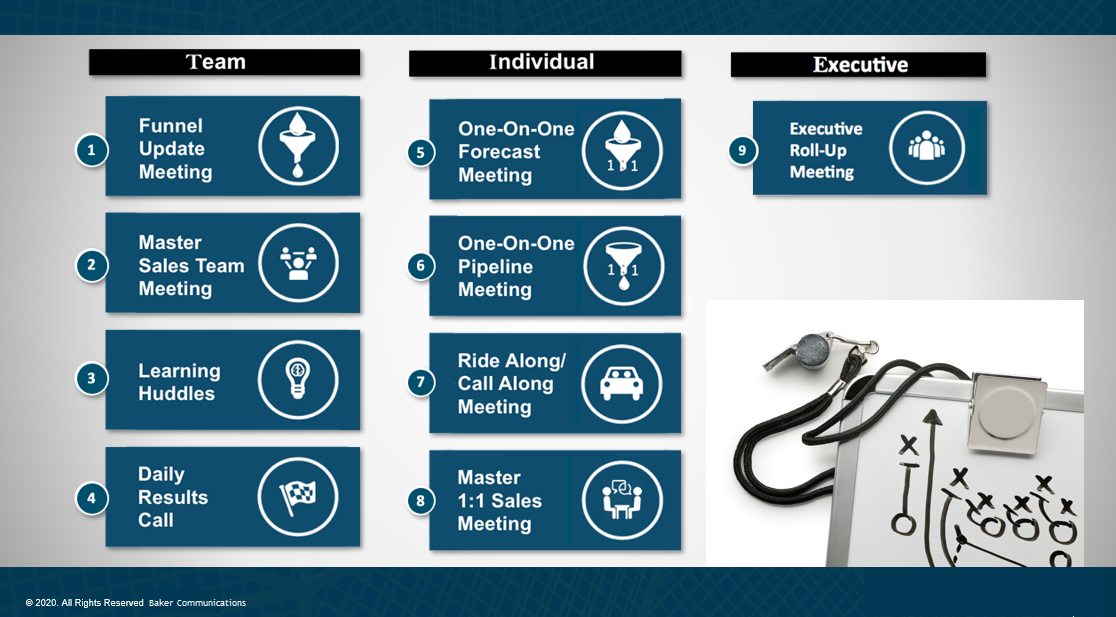
Each of these interactions give you time to see how individual team members are doing, as well as how the team is progressing towards their overall period goals. It also provides you with a very important management tool – an opportunity to coach. Without these types of daily, weekly, monthly, and quarterly interfaces, there really isn’t another way of gathering a snapshot of where you are and where you’re headed. It also gives you enough data to take corrective action before it becomes a problem that’s too late to fix – like a dwindling or inverted pipeline.
Step 2: Assess your team’s skills to find out their strengths and weaknesses. This is the “down-in-the-ditches” process of skill building and peer collaboration. We use data research on over 2 million sellers to drive this part of the process. It involves testing 21 competencies that the most successful reps in each type of selling role would display throughout the selling cycle. If you’re the Sales Manager, this data shows you how you’re going to ‘fix’ individual contribution problems with training and coaching.
Step 3: Assess Sales Manager Competencies. If you’re interviewing for the VP of Sales job, then this is another area you should focus on. Some statistics to digest are that only 1 in 7 sales reps possess the right competencies to become a Sales Manager. And conversely, only 5 out of 6 Sales Managers can be successful as an individual seller carrying a bag. Yet, we continue to promote our top sellers into these roles, thinking we’re doing the right thing. “Surely, they know what’s expected of them, and surely, they know how to find customers. Right?”
Believe it or not, Tiger Woods would probably not make the best golf coach, which is why he relied on his dad, Earl Woods to spot his weaknesses and to encourage him when he got himself into trouble. Think about the top 2% of the golfers on the LPGA or PGA. Can you name their coaches? Neither can I.
The same is true in our world. The skillset required to analyze, detect, and remedy weaknesses are the key elements of the job of the Sales Manager. The job of the Sellers is to be able to demonstrate and articulate – eloquently and convincingly – how they are adding value to a customer’s business.
Here again we rely on huge data resources. We test for the 20 competencies that make a great Sales Manager and then lay out a plan to either hire, or to re-train and re-coach our existing staff.
Step 4: Develop individual learning paths to get skills up to par for each player. Now that you have identified the strengths and weaknesses of everyone on your team, it’s time for action. Not everything will be a training intervention. Let me repeat that. Not everything will be a training intervention. As a Sales Manager or VP of Sales, you need to understand the motivations and fears of each team member, and then deal with those self-limiting elements, individually. Maybe your Sales Manager isn’t a great coach, but it will be your job to show him or her how to coach successfully. It may mean leaving egos behind and no more cowboy/cowgirl acts in the 11th hour to rescue a sale. Instead, it may mean that you need to show that person the skills he or she needs to grow individual team members.
The rest is easy by comparison. It’s about finding skill gaps and mapping them to training solutions. When you find out that an individual has a prospecting, research or closing skill gap, those are readily mapped to an individual training remedy.
Step 5: Develop individualized coaching plans for Sales Managers. Each Sales Manager is going to have a different portfolio of management and coaching skills that they’ve brought with them to the job. Some may be lacking in any one of the 20 disciplines that we use to evaluate a Sales Manager’s likelihood of success. Each one of those gaps will identify an opportunity for you to coach as a Sales VP, as well as provide overall training, such as how to implement a Sales Management System, or capturing a new market segment, or orchestrating a series of complex Sales Plays.
Step 6: Teach Sales Managers how to coach. What we do is to “coach the coaches.” We use an “I Drive – We Drive – You Drive” approach to show managers how to prepare for and run successful sales meetings (i.e., the 9 disciplines), as well as how to do individual coaching. This allows us to work with any “limiting beliefs” there may be that restricts an individual Sales Manager from being an outstanding coach. Consider this: if all deals must flow through your Sales Manager, you’re going to have trouble scaling that team’s revenue contributions. The better solution is to coach the individuals on that team to be star performers.
Step 7: Implement KPI’s to track baseline and improvement. You need to measure your starting point, and then track improvements along the way. If you don’t do that, what proof do you have of the impact of your leadership and training expenditures? There are many different KPI’s that might be important to a company at any particular time. Rather than call them all out here in a short blog post, you can refer to this very detailed document on our website: https://www.bakercommunications.com/dl/BCI-Key-Performance-Indicator-Guidebook-and-Addendum.pdf.
Want to know more? Please join us on July 17th for our webinar, “How To Build A World-Class Sales Team.” Please go here to register: https://www.bakercommunications.com/webinars/How-To-Build-A-World-Class-Sales-Team.html. If you’re reading this after the webinar date, you can watch the video recording for free as well.
