The fear isn't about the technology. It's that the thing you were respected for has become something anyone can do, and that the respect goes with it.
Somebody on your team wrote a proposal last week in about twenty minutes, and it was better than the one that used to take them most of a Thursday. They haven't mentioned it to anyone, and they're not planning to.
What's running through their head has nothing to do with the tool. It's a set of questions that turn up around eleven at night and don't have good answers. If I can do this in twenty minutes, how long before somebody works out they only need half of us? What happens at the next round of cuts, when a person with a spreadsheet goes looking for the roles that got easier? And then the one that reaches backward and lands hardest: if this takes twenty minutes now, what were all those Thursdays worth?
That last question is the cruelest of the three, because there's no good answer to it. It takes work they were proud of, work that built whatever reputation they have here, and makes it look like padding.
So next week, on the account that actually matters, they'll do it the long way. They'll stay late to get it done. They won't tell you why, and if you ask them, they'll say they wanted to take their time with it.
None of that's a guess. 52% of people using AI at work say they're reluctant to admit using it on their most important tasks, and 53% believe that using it makes them look replaceable. Both numbers come from the Work Trend Index by Microsoft and LinkedIn, drawn from 31,000 responses across 31 countries1.
The first one deserves a second read, because of where the reluctance sits. It's not on the routine work, where being caught using a tool would cost nobody anything. It's on the work that matters most. The pattern runs in a single direction: the higher the stakes, the more carefully a person hides the help, because the higher the stakes, the more it feels like their value is the thing being assessed.
So this costs you twice over, and the second cost is the expensive one. You lose the speed exactly where you most needed it, on the deals with the most riding on them. And somebody on your team spends their week learning that their standing here depends on keeping something hidden from you. That kind of damage never appears on an adoption dashboard, and it doesn't repair itself once it sets.
It's worth saying plainly what the fear actually is, because leaders talk around it constantly. Nobody is frightened of the software. They're frightened that the thing they were respected for has turned into something anyone can do before lunch, and that when the respect goes, the job follows it out the door.
The instinct at this point is to reassure everybody, and it comes from a good place. It also tends to make things worse, because what your team is carrying around isn't an irrational fear. They read the same headlines you do, and some of them have already been through a restructure that started out sounding reassuring too.
The World Economic Forum's Future of Jobs report, drawing on more than a thousand employers, found that 41% expect to reduce their workforce where AI can automate tasks. Nearly half anticipate moving people out of roles that AI has disrupted2. Those aren't warnings from critics. They're employers describing their own plans, in a report anyone on your team can read on their phone during lunch.
So when a leader stands up and says nobody is losing their job over this, one of two things is happening in that room. Either the leader doesn't actually know, or they do and everyone can feel the gap between the words and the situation. Both of those cost more trust than staying silent would have, and the second kind of cost tends not to come back.
There's no framework that solves this. What it takes is honesty about what you can and can't commit to, delivered by somebody the person already trusts, which is why it belongs in a small room and not on a stage.
Before we get to how the conversation goes, it's worth knowing what you can truthfully offer in it. There's a real answer here, and it holds up better than reassurance because it survives being checked.
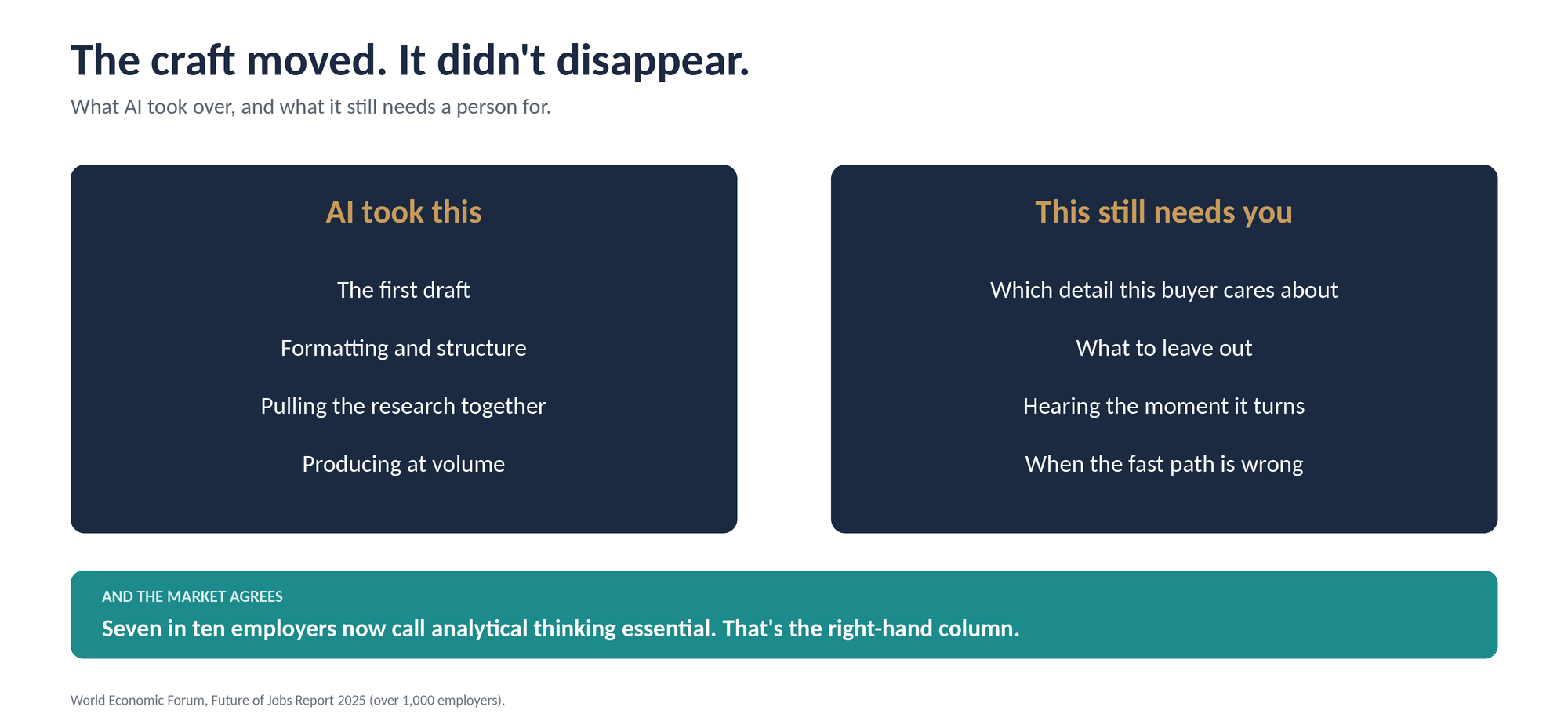
Look at what AI really did take over in a selling role. The first draft. The formatting and the structure. Pulling the research together. Producing at volume. That's all real work, and it's all faster now.
Then look at what it left completely alone. Knowing which of six details this particular buyer will actually care about. Deciding what to leave out. Noticing the moment a conversation turns and changing course inside it. Judging when the fast path is the wrong one.
The person who was best at proposals was almost never best because they wrote quickly. They were best because they knew what belonged in it. That skill hasn't been automated and it hasn't got cheaper. Employers agree, for what it's worth: analytical thinking is the skill they most often call essential, with seven in ten companies naming it, from the same Future of Jobs report2.
None of that means everybody's job is safe, and pretending otherwise would put us right back where we started. What it does mean is that the thing your strongest people were actually good at became more valuable rather than less. They will not work that out on their own, and they are unlikely to believe it the first time they hear it.
The format is deliberately small. Six or so people, run by their own manager rather than by HR or someone visiting from the leadership team, sixty minutes, once a quarter. No deck, no agenda, and nobody taking notes.
There's one question on the table, and it's not what skills do you need next. It's what does it mean to be good at your job now. Then you leave enough silence after it that somebody eventually fills it, which usually takes longer than feels comfortable.
The distinction that makes it work is the one between communications and coaching, and it matters more than it sounds. Communications tells people what's happening. Coaching helps a person work out what they think. If your session produces a slide, it turned into the first thing.
Most leaders skip this conversation for an understandable reason. They walk into it looking for something reassuring to say, can't find anything honest that fits, and decide the conversation would do more harm than good. That's the wrong conclusion, but it's a fair worry.
There's a version that works without a promise, and it's built out of the things you can actually control.
You can commit to telling people what you know when you know it, rather than after it's decided. You can commit to funding the learning instead of expecting it to happen on evenings and weekends. You can commit to being specific about what the role is becoming, so that nobody has to guess their way through the next year. And you can say, out loud, that you don't know how the next two years unfold, and that you'd rather work it out alongside them than pretend to a certainty you don't have.
None of that's comforting, and it's not supposed to be. It's trustworthy, and trustworthy is what the room is testing for.
| This Fails | This Works |
|---|---|
| A town hall with slides | Six people and one question |
| "Nobody is losing their job over this" | "Here's what I can commit to, and here's what I don't know" |
| "The industry is changing" | "The Thursday you were best at now takes an hour" |
| Running it once, after the announcement | Once a quarter, whether or not anything changed |
| Leading with what the company needs | Leading with what they'd keep if they had the choice |
| Producing a deliverable | Producing nothing except a different conversation next month |
Don't schedule a session yet. Start with one person, and pick the one who has been quietest about AI, because silence in this particular conversation usually means something.
In your next one to one, ask them a single question. What part of your job would you keep even if you didn't have to do it any more. Then stop talking and let the pause do its work.
Whatever comes back will tell you what that person is holding onto, and that's what you want to be ready for when you run the wider conversation later. Walk into a group session without knowing it and you'll get a room full of careful, considerate answers that teach you nothing at all.
There's no training program that gets you past this one. Somebody sitting with the question of whether their craft still counts for anything isn't going to be moved by a curriculum, and they're certainly not going to raise it in a setting where the honest answer carries risk for them.
What moves it is a leader willing to say the specific true thing, commit to whatever they can stand behind, and admit the rest out loud. That costs an hour a quarter and no budget whatsoever, and it's a good part of the difference between the teams learning fast right now and the ones sitting still, waiting to be told what happens to them.
Up Next: What a Learning Organization Does Differently on a Tuesday
Every company now says it wants to learn faster. Almost none of them can describe what that looks like on an ordinary day, which makes it impossible to tell whether it's happening at all.
The next post gets specific about it. Five things you'd actually see in a team that's learning quickly, none of which show up on a dashboard, and what to measure instead of the numbers most teams report.
Read the Next Post →Sources
Numbered citations throughout this article draw on the sources above.
