AI fluency gets you considered. Judgment gets you hired, kept, and promoted. Most teams are training for the first one.
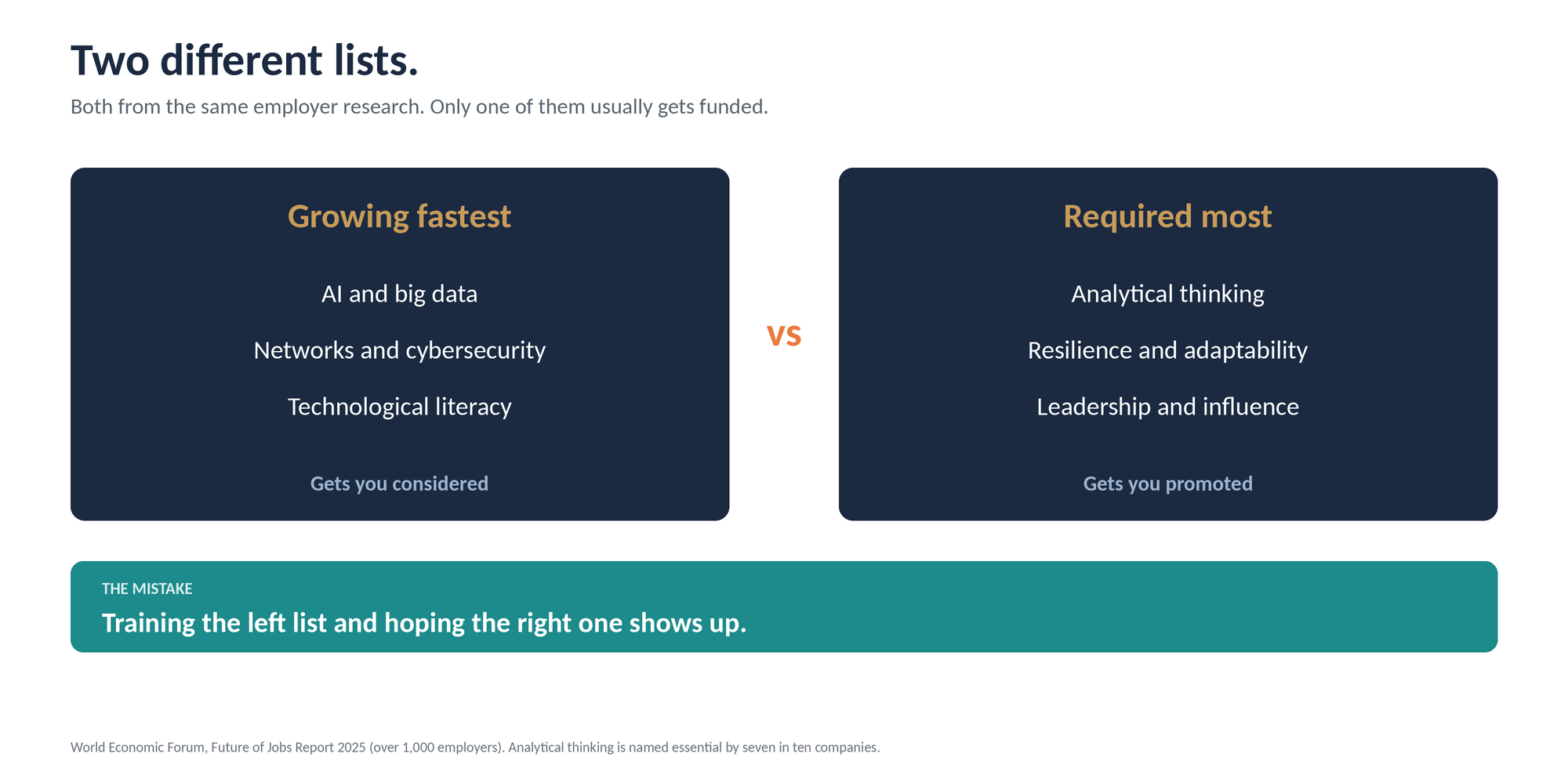
The technical demand is real, so start there. AI and big data top the list of fastest-growing skills, according to the World Economic Forum's Future of Jobs report, drawing on over 1,000 employers1. And 66% of leaders say they wouldn't hire someone without AI skills, with 71% saying they'd take a less experienced candidate who has them over a more experienced one who doesn't, from the Work Trend Index by Microsoft and LinkedIn, 31,000 respondents across 31 countries2.
So anyone telling your team that AI skills don't matter for hiring is wrong.
The part that gets left out sits in the same Future of Jobs research. The skill employers most often call essential is analytical thinking, named by seven in ten companies. After it come resilience, flexibility and agility, then leadership and social influence. Curiosity and lifelong learning are rising too1.
Fastest-growing and most-required are two different lists. The first is about what's newly scarce. The second is about what the work actually runs on.
Because the two lists point at different training budgets, and most teams are funding the wrong one.
Tool training is easy to buy, easy to schedule, and easy to report. A vendor delivers it, attendance gets counted, and the box is ticked. Judgment training is none of those things, which is why the gap survives even where leaders can see it. Workday's survey of 3,200 leaders and employees found two thirds of them calling skills training a top investment priority, and barely a third of the people carrying the most AI rework saying any of it has reached them3.
What that produces is a team who can operate the tools and can't tell when the tools are wrong. More output, worse decisions. It reads as productivity on every dashboard you have.
| Fastest-Growing Skills | Skills Called Essential |
|---|---|
| AI and big data | Analytical thinking |
| Networks and cybersecurity | Resilience, flexibility and agility |
| Technological literacy | Leadership and social influence |
| Easy to buy as training | Built through coaching and repetition |
| Gets a candidate considered | Decides who gets kept and promoted |
Both lists come from the same Future of Jobs research. Neither one is more important than the other. Only one of them usually gets funded.
Analytical thinking is an abstract phrase for something concrete. In a selling role it shows up in three places.
A features walkthrough teaches none of that. Repeated conversations about real work teach all of it, which is the slower and cheaper option nobody schedules.
Look at the last three AI-related training sessions your team attended and ask what each one taught. If all three were about operating a tool, you have your answer about which list is getting funded.
Then add one thing rather than replacing anything. Fifteen minutes in an existing team meeting where one person walks through a decision they made with AI, including what they checked and what they chose to trust. That's judgment training, and it costs a quarter of an hour.
Hire for AI fluency. The data on that's not ambiguous, and ignoring it puts a team behind.
Then train for the other list. That one decides whether the fluency produces better decisions or only faster ones. A team can be strong on the tools and weaker at the job, and no adoption metric you currently report will tell you.
Up Next: AI Hid the Symptoms You Used to Coach From
Naming judgment as the skill that matters takes one sentence. Developing it in someone else is the part nobody has been shown how to do.
The usual approaches don't reach it. Judgment doesn't fit on a slide, a quiz won't measure it, and a manager reviewing finished work sees the result of a decision rather than the reasoning behind it. The next post covers what actually builds it: the questions that surface reasoning, how to run the conversation without turning it into an audit, and what to do about the seller who gets the right answer and can't explain why.
Read the Next Post →Sources
Numbered citations throughout this article draw on the sources above.
