Some negotiators will resort to using manipulative tactics during the course of negotiations. It can be extremely helpful if we know how to recognize and neutralize these tactics when we encounter them.
While principled negotiators who are working for a win-win agreement generally do not
use manipulative tactics to close a deal, zero-sum negotiators certainly will, in the belief that additional leverage is more important than complete transparency.
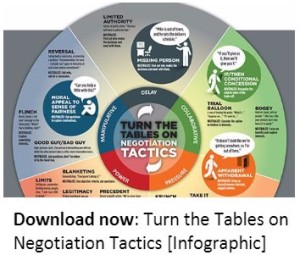 There are several different types of tactics; some are intended to make us feel pressured or intimidated, some to trick us into thinking we need to lower our aspirations or make more concessions. Some play on our need to close the deal; the more critical the negotiation is – and the fewer options we have – the more likely we are to give in and let these tactics work.
If we can learn to recognize tactics and how to counter them, were far less likely to fall into such a trap. Lets look at a few different types of negotiation tactics and some examples.
Pressure Tactics
Sometimes the other party makes statements that are meant to increase pressure or create anxiety about getting the deal closed or missing an opportunity. If the other party mentions an impending deadline, talks about going to our competition, or givesus a take-it-or-leave-it ultimatum, we shouldnt panic and start making bad decisions or unwise concessions.
A few examples of pressure tactics include:
- Deadline –Pressures us to make choices quickly; forces a closure or delay. “I have to leave in 15 minutes.
- What we should do: Ask questions to test the reality of the Deadline. If it is genuine, find out what happens if the Deadline passes. Then decide whether to work with or around it.
- Competition – Lowers our aspirations. “I’ll have to send this out for bids. Your competitors are offering discounts.”
- What we should do: Ask questions. Which competitors do they mean? Are they really offering discounts? What do they have – is it actually comparable to the offering on the table?
- Take It or Leave It – This is negotiation by ultimatum. “This is my final offer.”
- What we should do: Ask questions to test how serious they are. Listen for loopholes. (Another approach is to ignore the ultimatum and simply continue with the negotiation – if they really meant it, all they have to do is stick to their guns.)
Delay Tactics
Delay tactics are just what they sound like – attempts to delay a final decision. There can be a number of reasons why forcing a delay might create leverage for the other party, and reasons why we would want to avoid it. Often, these tactics involve a reference to someone who’s not at the table.
Some examples are:
- Limited Authority – They claim that final authority for approving an agreement rests elsewhere. “The boss will have to authorize this.”
- What we should do: Ask questions. Find out who really makes the decisions, and see if we can meet with them instead, if its not the person were talking to.
- Missing Person – Similarly, referring to someone who is not present who needs to be involved. “Mike is out of town, and he sets the delivery schedule”. “Our legal team will need to set the language for the contract.”
- What we should do: Ask how to get in touch with these people and get these issues handled.
Manipulative Tactics
While many negotiation tactics are manipulative in nature, we use this category to cover tactics that are actually intended to trick or mislead us. They tend to have a high emotional content and are designed to elicit a certain reaction that is probably not in our best interests.
Such manipulative tactics include:
- The Flinch – They recoil, physically and/or verbally. Sends a strong not okaymessage and makes us want to fix the problem. “What?! You’re kidding, right?”
- What we should do: Ask questions to find out why they feel the proposal is unreasonable, and explore their underlying interests.
- Good Cop/Bad Cop – We all know how this one goes; we face a multi-person team in which one person is demanding and difficult, and the other person takes a softer, more reasonable stance.
- What we should do: Ask questions; don’t be intimidated by the Bad Cop or get taken in by the Good Cop. (Just because their stance sounds more reasonable than the Bad Cops doesn’t mean its in our best interests!)
- Moral Appeal – An attempt to appeal to our sense of fairness, often in hopes of gaining a concession. “Can you help us out a little here?”
- What we should do: Ask questions to explore their interests and motivations. Why do they need us to help them out, and what will they do in exchange? (Always remember Quid Pro Quo!)>
Power Tactics
These are tactics that are intended to leverage the other partys (real or illusory) power over us. A power play should not be allowed to stand between us and a win-win outcome.If we explore their underlying motivations and insist on using objective criteria, we can often get past the power tactic and back onto a level playing field.
Such techniques include:
- Blanketing – They justify their actions by generalizing. Everyone is doing it this way.
- What we should do: Ask what they mean by “everyone” and get more specifics. Make sure objective criteria are being used.
- Legitimacy/Precedent – Justifying actions according to some authority such as printed documentation or standard process. “Our standard contract stipulates these terms“. “We’ve always done it this way“.
- What we should do: Ask questions around objectivity; determine how the precedent was set, how applicable the standard terms are to the current situation, or what effect making a change would have. Why does the other party want to maintain the status quo? What are their real reasons?
The Final Question

So whats our take-away from all this?
We can see there’s a definite pattern here: every single counter starts with asking questions!
Its always best to gain more clarity when we think the party on the other side of the table may be using any kind of tactic.
Asking questions can help us determine whether the issue they have raised is genuine or a mere tactic, and find ways to make the deal work without buckling under pressure. The more information we have, the better our chances of building a successful conclusion.
Baker Communications offers leading-edge Negotiations Training solutions that will help you address the goals and achieve the solutions addressed in this article. For more information about how your organization can achieve immediate and lasting behavior change that leads to bigger wins during negotiations in any setting, click here.