“If he wins, I lose. If I win, he loses.” That’s a zero-sum game. If one person succeeding means someone else fails, what does that do to our business partnerships?
At Baker Communications, we are big fans of “win-win” negotiating, where the idea is to build an agreement that works well for all the parties involved. In the win-win game, everyone succeeds. We wish everybody approached their dealings that way.
However, there are still some old-school, winner-takes-all negotiators out there. So what’s a win-win negotiator to do when faced with someone who isn’t above playing dirty, manipulating us and using underhanded tactics to get their way? Daunting as that prospect might be, at least it’s possible to be prepared.
Types of Tactics
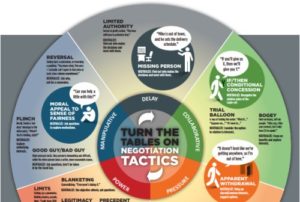
Most tactics fall into one of five basic categories. Once we know how to recognize them, we can identify when someone is trying to use them, and move to counter or neutralize the tactic in play – or employ our own to get things back on track.
First, there are Pressure Tactics. These are maneuvers that play on the fear of losing the opportunity to close a deal, forcing us to make unwise concessions to “keep the deal alive.”
There are also Delaying Tactics, which are moves that drag out the process and buy time for gaining information or implementing other tactics.
Manipulative Tactics are intended to trick us, deceive us, or leverage our emotions so that we might make a decision that is not necessarily in our best interests.
Then, there are plain old Power or One-up Tactics. These are intended to discourage us from even thinking about challenging the other side’s position in the first place.
Finally, there are Collaborative Tactics. These actions are actually designed to build trust and find mutually beneficial solutions. Collaborative Tactics can be used to redirect the negotiation onto a win-win track.
Neutralizing Pressure Tactics
Sometimes in negotiations the other party makes statements that increase pressure or create anxiety about getting the deal closed or missing an opportunity. While principled negotiators who are working for a win-win agreement generally do not use manipulative tactics to close a deal, zero-sum negotiators certainly will, so it’s a good idea to ask questions when such situations arise.
If the other party creates pressure – perhaps by mentioning a deadline, talking about going to the competition, or giving us a take-it-or-leave-it ultimatum – we can’t let it panic us into making bad decisions or unwise concessions. Instead, we ask questions. What happens if we miss the deadline? Is the competition’s offering comparable to ours? Are they really ready to walk away if we don’t agree to their ultimatum?
Neutralizing Delaying Tactics
If the other party is making efforts to stall or defer decisions till later – perhaps citing limited authority to finalize the deal, or saying someone else needs to approve it first – it may be a delaying tactic. These tactics tend to lower our aspiration levels. They may also be efforts to sideline issues they don’t want to discuss, buy extra time, or avoid making a decision.
Most of these tactics can be neutralized preemptively if we simple ensure we’re talking to the right person to begin with. Make sure the other negotiator has full authority to make decisions and sign off on the agreement. If they don’t, find out who does and ask to meet with them instead. There’s no reason for us to waste time negotiating with someone who can’t make a deal with us.
Neutralizing Manipulative Tactics
Manipulative tactics are moves intended to throw us off our game, whether through emotional manipulation, sudden reversals, or tag-team assaults. If the other side starts playing “good cop/bad cop” or taking back concessions, it can be disorienting. We need to make sure we don’t end up accepting a deal with terms that aren’t actually acceptable for us.
Even less obvious, friendlier moves – like appealing to our sense of fairness – can actually be manipulative. We ask questions to find out about their motivations, and guard against the impulse to do them a favor unless it’s also in our best interests.
Neutralizing Power Tactics
A tactic that is intended to provide leverage to the other party can be considered a “power” tactic; such techniques include justifying actions through blanketing (saying “everyone is doing it”), precedent (“we’ve always done it this way”), or documentation (“our standard contract stipulates these terms”).
Again, the key to neutralizing these power plays is to ask lots of questions. Who is “everyone”? Why does the other party want to maintain the status quo? Where did this precedent come from? What are their real reasons?
We shouldn’t let a power play stand between us and a win-win outcome. If we explore their underlying motivations and insist on using objective criteria, we can often get past the power tactic and back onto a level playing field.
Working for the Win-Win
In general, the more information we have, the better our chances of building a successful conclusion. Asking questions can often help us determine whether the issue at hand is genuine or a mere tactic. Then we can find ways to make the deal work, without buckling under pressure.
Baker Communications offers leading-edge Negotiations Training solutions that will help you address the goals and achieve the solutions addressed in this article. For more information about how your organization can achieve immediate and lasting behavior change that leads to bigger wins during negotiations in any setting, click here.