The challenge of employee motivation is certainly not a new one. The stick or carrot debate is ages old. What works best, rewards or punishments – or a combination? How can we get employees to do what we want?
And is that really the question we should be asking?
Effective managers are constantly on the lookout for ways to inspire and motivate their employees toward excellence and higher levels of achievement. Even though this task can seem daunting, managers who are careful to observe one important principle will soon discover ways to keep their employees focused and motivated through a wide variety of changes and challenges in the workplace.
The principle is a simple one. We don’t need to waste time trying to motivate employees to do what WE want; instead, we work to discover what our employees already want to do, and find ways to help them do that work and achieve those goals.
Motivation, defined simply, is the impulse to make change. It is the drive that compels someone to act. Motivation is not something that we can give someone or make them feel; it comes from within the person. However, we can use external factors to influence motivation.
Human behavior is goal-directed. While motivation can only come from within, goals can be internally or externally imposed. The challenge is getting our people to accept the organization’s goals as their own – or better yet, finding ways to incorporate the goals and interests our people already have with what they need to accomplish in the workplace.
People who are committed to achieving organizational objectives consistently outperform those who are not committed. Employees who are intrinsically rewarded by their accomplishments in the workplace are more satisfied with their jobs and tend to have high self-esteem. This means our task involves making the work more satisfying and rewarding for employees.
It sounds simple enough, but considering the diversity of the contemporary workplace, it’s a complex task. What people find rewarding varies wildly from person to person –we can’t assume that what works for us will work for everyone.
Many employers tend to view pay rates and benefits as the primary motivators for their employees, but the truth is more complicated.
While dissatisfied employees do tend to complain about tangible areas such as pay and benefits – as well as physical working conditions, management practices, and company policies – these factors largely represent maintenance issues. Deficits in these areas can certainly produce dissatisfaction, but good pay and working conditions are often not enough by themselves to provide real motivation, where employees are engaged and pushing to excel.
When employees talk about true job satisfaction and the times when they really feel motivated, they don’t talk as much about money. They refer to things like a sense of achievement, to doing something worthwhile, to feeling recognized for their work. They may talk about enjoying the process – having a sense of satisfaction in the work itself. They may like the sense of empowerment and autonomy offered when they are entrusted with more responsibility, or the sense of achievement they get from growth and advancement. They talk about being enabled and encouraged to realize their own potential.
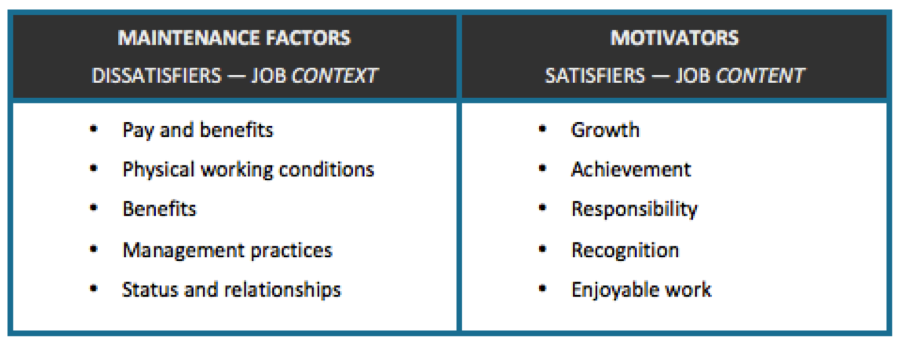
We can list a number of factors that contribute to employee motivation, but each individual may rank their importance and influence differently.
What motivates one person does not necessarily motivate the next – and according to circumstances, an individual’s motivation factors can change over time.
This is one reason it’s important for us to know what’s going on in the lives of our team members. Life changes can drastically alter what an employee considers important.
Here are some common motivational factors. What seems important? What sounds less important? Imagine a major life change, and consider how that might influence the rankings.
____ Mentoring
____ Benefits
____ Advancement/Promotion
____ Increased Responsibility/Authority
____ Time Off
____ Job Security
____ Business Social Opportunities
____ Professional Growth (seminars, etc.)
____ Recognition
____ Monetary Compensation
If we can determine where our employees’ focus might be with regard to these motivating factors, we will have a much clearer idea of what we can do to help them become more engaged with their work and achieve greater success.
The manager’s job is to facilitate an environment that enables employees to have interesting, challenging work, satisfying social relationships, and some recognition and autonomy in carrying out their duties. Here are five management practices that contribute to employee engagement and lead to higher levels of motivation:
Baker Communications offers leading-edge Management Training solutions that will help you address the goals and achieve the solutions addressed in this article. For more information about how your organization can achieve immediate and lasting behavior change that leads to better performance and greater productivity, click here.
