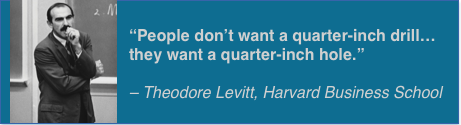
Theodore Levitt – economist, professor, author, and editor of the Harvard Business Review – is known primarily as a marketing guru. Thus he (and the above quote) may be better known in marketing circles than among sales professionals. Its applicability, however, is nearly universal in the business world.
Why? Because we all have a tendency to sell product features.
We know what our offering has that’s better than the competition, or better than the previous model, or unique in the marketplace. The problem is that we can tell our customers about product features until we’re blue in the face without ever connecting any of that information to their actual needs – which is where their focus really lies. It’s not a wise strategy to trust that the customer will bridge that gap all by themselves.
What we’re really talking about here is the difference between features and benefits.
A feature is a characteristic of a product or service. Features include attributes like size, color, quantity, technical specifications – all the stuff we’re experts on. A benefit, on the other hand, is the value to the customer. What exactly is that feature we’re so excited about actually going to DO for them? What’s the outcome going to be if they opt to buy our offering?
 Telling a customer about the product’s features is all about us. Telling them the benefits makes it about them. Once the customer is clear on what’s in it for them, they can better understand why they should choose to buy.
This is why Levitt insisted that people don’t want to buy a quarter-inch drill; what they seek is not a feature, but a benefit, a result: a quarter-inch hole. The job of the marketer or the salesperson is thus not to simply present the drill’s specifications, but to explain why using it is the best way for the customer to get the exact type of hole they want.
Attributes don’t sell products; results do.
Theodore Levitt’s central tenet was that businesses needed to be customer-oriented rather than product-oriented. His revolutionary book, Marketing Myopia, asked companies to define what business they were really in. Many companies in the railroad industry failed, he observed, by thinking they were in the railroad business, when in fact they were in the business of transportation.
“An industry begins with the customer and his or her needs, Levitt wrote.
Businesses can clearly benefit from this customer-oriented approach.
One of the major keys to the success of Apple, for example, has been the company’s intense focus on its users.
Steve Jobs insisted that Apple develop and market products that were intuitive to use, aesthetically pleasing, and integrated into customers’ lifestyles.
Accordingly, Apple’s marketing and sales approach has focused on customer experiences, not on technical specifications. Commercials depict active people using Apple products in their daily lives, not lists of features. Everything from Apple’s retail store design to its product packaging is focused on the user experience– and this approach has led to such success that other companies have scrambled to emulate them.

Our customers are focused on just one thing: their own priorities. They are looking for specific outcomes or results – in other words, benefits– that resolve problems or close gaps in their business. The only question the customer really wants answered is: What’s in it for me?”
This question can’t be answered with features alone. The key to helping a customer reach a buying decision lies in clearly spelling out the value that we can offer to meet their explicit needs – connecting a product feature to a clear benefit, a drill to a hole.
Before we can make this connection for the customer, we have to get good information about the customer’s needs. Good research and a solid questioning strategy should give us a picture of the customer’s situation. Once we find out that what the customer wants is a hole, what size hole they need, and what they hope the hole will let them do, we’re finally ready to talk about how our drill can help them accomplish their goals.
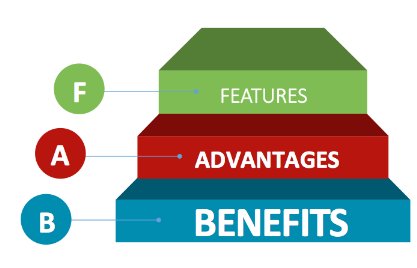
Feature-Advantage Benefit
One of the most reliable ways we can use this information is by incorporating it into a FAB statement.
FAB stands for Feature-Advantage-Benefit – a three-part statement that clearly connects a product feature to a customer benefit by bridging them with an advantage. The advantage simply tells how the stated feature produces the stated benefit: it’s what the feature does.
FAB statements can be used to build value during the customer interaction and to communicate the solution to defined customer problems – letting the customer know very clearly what’s in it for them.”
For example, if we are selling a computer to a customer whose stated interest is in improving efficiency, we can point out that our new processor (feature) increases computing speed (advantage) and contributes to efficiency and productivity (benefit).
To maximize the effectiveness of our FAB statements, keep these 3 things in mind:
It’s only important if the customer says it’s important. Benefits usually fall into one of the PPI categories: Productivity, Profitability, or Image. Listen closely to the customer: what do they really want? Are they seeking to reduce costs, increase profits, improve productivity, enhance efficiency, reduce downtime, improve their image? Then determine what feature of the offering confers an advantage that would contribute to that benefit. How can our product help them achieve their goal?
The more specifically the benefit can be stated – both in terms of the customer’s explicit needs, and in the measurability of results – the more effective it will be. A 10% increase in profits or a 72% reduction in downtime has more impact than a more general statement.
It’s ideal to frame the FAB statement around a feature that represents our competitive advantage over the competition – something that is unique, different, or better about our offering. What about this product or service will confer an advantage the customer can’t get anywhere else, and result in an improved outcome?
Baker Communications offers leading-edge sales training solutions for sales makers and sales managers that will help you address the goals and achieve the outcomes addressed in this
article. For more information about how your organization can achieve immediate and lasting behavior change that will uncover new opportunities, drive revenue, and boost your bottom line, click here.
