By Joe DiDonato | Chief of Staff | Baker Communications
Would it surprise you that 74% of the sellers applying for a specific sales position are unqualified? Did you know that only 1 in 7 sellers are capable of being successful as a sales manager? Would it shock you that 5 out of 6 sales managers would not be successful as an individual sales representative? Although some of these statistics seem counter-intuitive, they are very real, and based on Big Data that’s been collected over the past 3 decades.
Think about it. How many companies promote their best sellers to a sales manager role? It happens all the time. The thinking is that the person must know a lot about our products and customers to be this successful. Surely, he or she can teach, coach and lead the others. It’s that last assumption that causes the problem. Remember the opening stats, only 1 in 7 sellers can be successful as in Sales Management. It’s really a different skill set.
Unfortunately, we do this to ourselves all the time, and it’s the worst of both worlds. We lose our best sellers, and then the person fails to grow their team’s skillset to the next level. In many cases, the Sales Manager becomes the 11th hour Super Seller that rushes in to close an important deal, because they never taught their team how to do it. Unfortunately, that rescue might have caused 6 other deals to fall off the cliff, because the people never learned how to close their deals.
Let’s switch gears and begin to home in on the data issue. Imagine if you will, having a doctor prescribe medication to you without performing a physical or even asking questions about your symptoms. That’s kind of like buying a magic “cure-all” elixir from the back of a covered wagon in the Old Wild West. With the sophisticated diagnostics available to physicians these days – lab tests, x-rays, ultrasound, MRI’s – as well as CDC data on contagious diseases to be on the lookout for in their patients, we are able to pinpoint a patient’s problem accurately, as well as prescribe a path to wellness by using more than guess work.
In our world of sales, we have this diagnostic capability today. We can use Big Data to compare seller competencies against their peers across an industry, as well as analyze their skills from a variety of perspectives, such as their will to sell, their development capability, their leadership capability, as well as their organization or role fit.
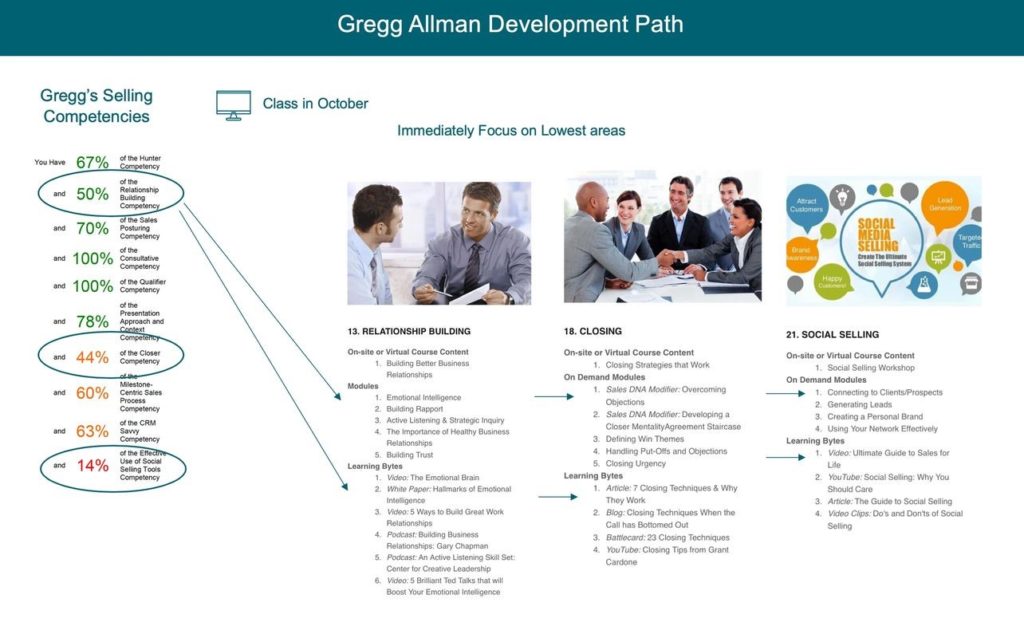
So why not use this data as the starting point, and then map our training to fill whatever gaps we discover?
Seems elemental, but most sales training is recommended and delivered without knowing any of this data about their sellers. How effective can that training be? Even worse, we often hire new sellers without knowing any of these details about them.
Using a Kevin O’Leary line from Shark Tank: “Stop the insanity!”
Fortunately, mastering a data-driven approach to sales training is getting easier all the time. The data we have available to us now has a very high predictive validity. The assessments that we use predict sales success with a 96% accuracy rate and is based on research from over 1.7 million sellers in over 26,000 companies, across 200 industries spread across 115 countries. These assessments measures 21 sales competencies and 28 sales management competencies. On new hires, 92% of the recommended and hired candidates have reached the top half of their sales team within 12 months.
So, this is where we need to begin our sales training efforts. We start with the data and we need to follow these 10 general steps:

If you would like help to craft this solution for your specific company and sales team, we would be honored to work with you and your team.
