Ever hired a salesperson who interviewed well but underperformed? You're not alone. 42% of hiring managers struggle to find qualified sales candidates1, and mis-hires can damage pipeline, revenue, and morale2. While pressure to hire quickly is high, accurate hiring matters more for long-term success3, 4.
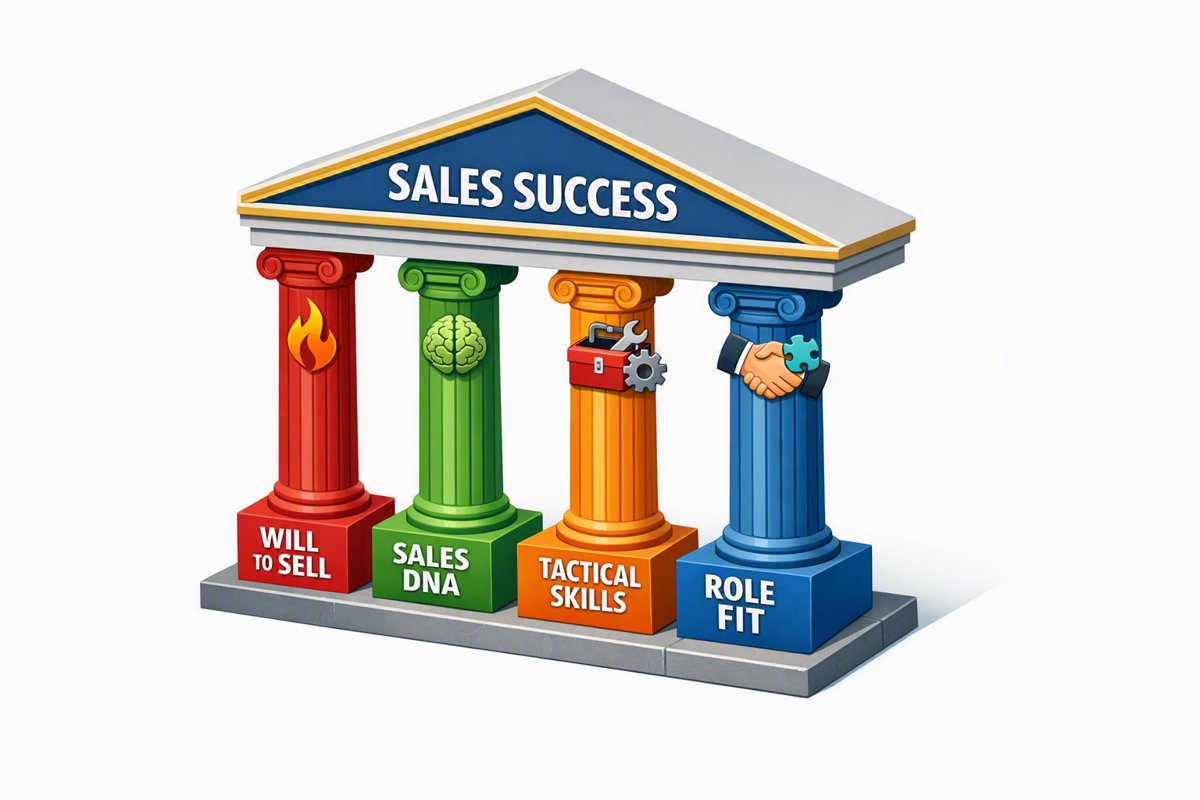
BCI's strategic partner, Objective Management Group (OMG), assesses more than 80,000 salespeople and candidates each year5, and finds that successful hires excel in four areas: Will to Sell, Sales DNA, Tactical Skills, and Role Fit6. These drivers support consistent sales success for both organizations and individuals. This post explains each in practical terms and why they matter for building high-performing teams and thriving salespeople.
Shortage of Top Sales Talent
42%
Hiring managers who can't find qualified candidates
Hasty vs. Accurate
7/10
Leaders say hiring quality is key to competitive advantage
Data-Driven Evaluations
80,000+
Salespeople assessed annually by OMG's data tools
Will to Sell is the engine of sales performance. It captures a person's intrinsic ambition and commitment to succeed specifically in sales7. A salesperson with a strong Will to Sell has an inner drive that pushes them to put in the effort and persistence required for success, even when the work is challenging8, 9.
Psychologically, Will to Sell parallels grit: passion and perseverance toward long-term goals. It's built on factors like how strongly a person wants to achieve, their willingness to do the hard work, their compelling "why" to fuel effort, an ability to own outcomes good and bad, and a positive mindset about their future in sales10, 11. Together, these qualities shape whether a salesperson will consistently do the right activities even when no one is watching.
Why do organizations struggle with this? Will to Sell is hard to detect and harder to teach. Product knowledge can be trained, but hunger, resilience, and internal drive must largely already be present12, 13. Commission plans help, but many sellers are driven more by personal goals and achievement than external reward14. If an individual's inner drive is lacking or misaligned, no external incentive can fully compensate for that missing spark.
Why it's vital: Strong Will to Sell drives activity, resilience, accountability, faster ramp-up, coachability, and focus in tough conditions15, 16. Such reps ramp up faster, respond positively to coaching, and stick to their goals even in tough times17. For the salesperson, it creates the "sales fuel" behind engagement, growth, and achievement.
Sales DNA is the psychological wiring behind sales behavior: beliefs, attitudes, and emotional responses that shape how a seller acts under pressure18. In essence, it's what a person believes about themselves, the sales process, and how they relate to buyers. It includes factors like comfort discussing money, need for approval, views of the buying process, and resilience to rejection: it's like the "operating system" behind default responses when deals stall or buyers push back19.
If someone's Sales DNA isn't supportive of sales success, they may have self-limiting tendencies that sabotage outcomes despite otherwise strong skills or experience. For example, need for approval may prevent tough questions, while low rejection tolerance can stall prospecting. These patterns are ingrained, hard to detect in interviews, and difficult to coach away20.
From a behavioral view, Sales DNA is about mindset and cognitive habits. It reflects self-efficacy (confidence in one's capabilities) and locus of control (whether someone takes responsibility or blames external factors). A salesperson with strong Sales DNA tends to have supportive beliefs: they believe in their value, aren't afraid to challenge prospects, and see rejection as part of the process rather than a personal failure21.
Why it's vital: Sales DNA has one of the biggest impacts on long-term sales success — even more than raw skills, according to multi-year data analyses22, 23. For organizations, it supports confidence, mental toughness, and proactive revenue-driving behavior. For individuals, it reduces stress and improves resilience in difficult buyer conversations24, 25.
Tactical skills are the nuts-and-bolts abilities that every salesperson needs to execute the job, like prospecting, asking great questions, qualifying opportunities thoroughly, presenting value, negotiating, and closing deals26, 27. These skills are visible and measurable: one can observe them in action, coach and improve them through training, and track progress via metrics (calls made, conversion rates, etc.)28, 29. Most sales training programs traditionally focus here because skills are tangible and easier to influence directly than personal traits or beliefs30.
From a behavioral perspective, tactical skills rely on knowledge, practice, and cognitive ability. A person with tactical capabilities has strong procedural knowledge of the sales process (they know what steps to take) and the communication skills to carry them out effectively. But keep in mind: even these skill areas can reflect underlying cognitive and emotional strengths. For example, skillful qualifying requires active listening and critical thinking, and adept closing takes social confidence and adaptability.
Why do companies still hire skilled salespeople who underperform? Because skills alone don't guarantee success. Performance gaps often show up in advanced skills like consultative selling or engaging decision-makers31, 32. If someone's Will to Sell or Sales DNA is lacking, their skills might never be put to use consistently33. That's why training can create short-term bumps but not sustained improvement if deeper factors aren't addressed34.
Why it's vital: Solid selling skills are table stakes. They help organizations ramp sellers faster, reduce basic mistakes, and let managers focus coaching on higher-value improvements35. For individuals, strong skills build confidence, competence, and lower stress. Ultimately, the best outcomes arise when tactical skills are combined with a strong Will to Sell and healthy Sales DNA: skill is the what and how, powered by the why and belief behind it.
Role Fit is about how well a person's strengths and tendencies align with the specific requirements of a sales role36. Not all sales jobs are alike: inside sales, enterprise sales, hunting, and account management require different profiles37. Role Fit recognizes that a candidate can be talented, but in the wrong role, they may struggle.
In psychological terms, Role Fit relates to the concept of person–job fit: people perform better and feel more satisfied when work matches their preferences, abilities, and environment. What matters is matching the person to the right environment. A mis-hire often simply means a mis-fit: you might have a capable individual placed where they can't play to their strengths.
Why it's vital: Strong Role Fit improves productivity, retention, and consistency. Sales teams struggle when they put square pegs in round holes, while high-performing cultures put the right people in the right seats38, 39, 40. For individuals, fit supports engagement, confidence, motivation, and satisfaction.
The common thread across these four success drivers is that they're not obvious from a résumé or one great interview41, 42. Traditional hiring methods (generic personality tests, unstructured interviews, or gut instinct) often miss these critical qualities, focusing instead on easily observable traits like charisma, past experience, or presentation skills43, 44. But as we've seen, a polished interview doesn't guarantee resilience, coachability, or role alignment in the field45, 46.
The good news: tools like the sales hiring license (Sales Candidate Assessment from BCI's partner OMG) help quantify these factors before you hire. Data-driven assessments measure 21 sales-specific competencies across Will to Sell, Sales DNA, and Tactical Skills47, and results can be tailored to the exact role to ensure role fit48. This diagnostic approach acts like an MRI for sales talent, revealing under-the-surface strengths and risks conventional methods miss49.
By embedding these four pillars into your hiring process, and using objective data to assess them, organizations can make more confident hiring decisions. They can identify candidates with the internal makeup and skills to succeed, not just those who look good on paper or in an interview. It's not about hiring faster but hiring smarter: building a team of sellers who will stick, perform, and grow with the business50.
In summary, the four drivers isolated by OMG's research (Will to Sell, Sales DNA, Tactical Skills, Role Fit) are each critical, but it's their combination that creates high sales performers51, 52. For companies, focusing on these areas means fewer costly mis-hires, stronger sales results, and a more resilient team53, 54. For sales professionals, it means being placed in roles where they can thrive, supported by the right mindset, motivation, skills, and environment to unlock their full potential. By treating sales hiring more like science than art, organizations can build teams that consistently outperform, while salespeople build fulfilling, successful careers.
Sources
Numbered citations throughout this article draw on the four sources above, courtesy of Objective Management Group.
