Have you ever attended a training course where right away you start to wish you were someplace else – in fact, anyplace else, doing something else?
Right away, as you settled into your chair and heard the course introduction, maybe you thought to yourself:
We have all been there before – and there is nothing worse than a boring class. Even when the instructor has the expertise, if they cannot make their message resonate with the audience, the experience turns out to be a waste of time.
The best classes I have attended were ones where I was actively engaged in the learning process. Even when the message was not new and there was no direct correlation to what my job was, interacting with the instructor and the other participants helped me to take responsibility for the educational experience. And I had fun!
In my experience, the best workshops are extremely interactive experiences that incorporate a variety of approaches to accommodate different learning styles. By having a variety of activities, the key learning objectives reach different types of people.
Rather than simply giving a lecture that involves participants doing a lot of writing and memorization, the instructor’s role is to make the content come alive with activities, case studies and role plays. Even when a real-world situation is being simulated, for example, negotiating with customers, the instructor needs to create a safe environment where people can try new approaches and even make mistakes. By getting feedback from colleagues, they can improve and put the teaching into action.
Just as a group of people with different cell phone providers find that some have better coverage in certain areas than others, certain messages resonate with some people more than others. For example, one teaching point that we use in many of our workshops, such as management and negotiations courses, is behavioral styles. Different audiences respond in very different ways to this concept.
Categorizing people into four distinct groups dates back thousands of years. In ancient Greece, Hippocrates, the father of modern medicine, used “choleric, phlegmatic, sanguine, and melancholic.” Fortunately, the styles we use are easier to remember: Doer, Talker, Thinker and Guardian.
There is a great deal of literature describing the four types. In a nutshell, below is a brief summary:
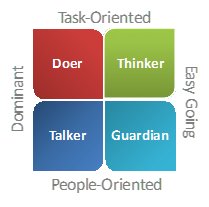
Another way to think about this graph is that people-oriented styles, Talkers and Guardians are more informal, while Doers and Thinkers are much more concerned about processes.
Also, dominant styles (Doers and Talkers) are more apt to tell others, rather than ask them.
Here is a link to an easy assessment of these four styles. And this video will give you an overview before you do the assessment:
When you take the assessment, you will not only see what your style is and get access to a video describing that style in detail, you will also see where you are in the grid. It is important to note that each of us is not solely one style, but instead, blends of different styles. However, unless you are right in the middle, we each have a primary style.
One of the purposes of taking this assessment is to simply be aware of your style. By understanding our strengths, we can leverage them and flex to different situations.
Another reason why these styles can be helpful is to recognize the style of other people so you can know how you might need to adapt when working with them.
During a workshop, the instructor might break up the class into four different groups based on their behavioral styles. The way that they interact with each other and present to the rest of the class is often a great illustration of what makes their group unique. If given a task to whiteboard ideas:
Understanding behavior styles helps facilitators to understand the audience. Once, when I was teaching a group of very technical salespeople and engineers in Tokyo, I found it difficult to get responses to my questions. Since I was speaking Japanese, I started to doubt if I was communicating clearly and if they even understand what I was saying. After I paused to check in, it became clear that everyone was simply considering what was being said, so I adjusted my approach to teaching. When we got to the behavioral styles section, it was not surprising to see that almost everyone fell into the Thinker category.
If you would like to take the assessment, you can click on the link earlier in the article. If you are a Doer, you might want to start right away. The process should only take a couple of minutes, but could a little bit longer if you are a Thinker.
And for you Thinkers, and anyone else who like to have more detail on the four different behavioral styles, you can download a reference guide. This one-pager describes the character traits of each style along with their primary emotions, fears, and needs. This will not only help you recognize the styles of others but also provides some tips on how to interact with them. Here is the link.
Author: