How Do You Sell Value in a Recession?
One of the areas where we see a consistent weakness in sellers is selling value. Sixty-nine percent of all sellers show this skill as a weakness. Unfortunately, this will get amplified during a recession when budget and spending changes are pervasive. To that end this article will focus on a simple equation for selling value and give you examples of how this can be taught to sellers to accomplish this with their customers.
What's The Value Equation?
To answer this question, let's look at the equation which was originally put forth by Alex Hormozi in the B2C space and then modified by me to make it fit better to our B2B language:
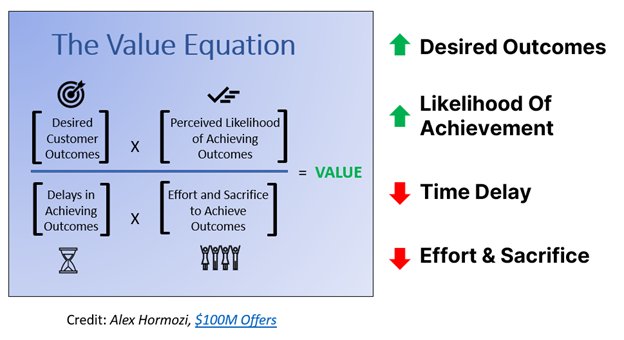
The way this works is that you're trying to get as close to 1 point for each of the four bracketed areas. The total possible is 4 points. In the top, the numerator, you're looking to increase those areas of the solution that best increase the customer's desired outcomes. You're also looking to increase the perceived likelihood of success in achieving the outcomes that the customer desires.
In the bottom part of the equation, the denominator, you're attempting to minimize these areas. Delays in achieving the outcomes or the amount of effort your customer must go through to achieve those outcomes is going to work against you.
An Example We Can All Relate To
As an example, let's say that you're trying to lose weight and achieve a certain body shape as two of your key goals. You might find yourself comparing solutions that are quite different from one another. For instance, if you are choosing between joining a gym, like in Alex Hormozi's world, you might also be considering Ozempic® diet pills or CoolSculpting®. In your mind, Ozempic sounds like a sure winner, as well as CoolSculpting® because they all produce the same outcomes as a heavy gym workout schedule without all the effort.
If you're in Alex's shoes, you need to prove that by coming to your gym for 3 months and using his fast weight-loss program that combines 1 trip to the gym 5 days a week and a strict low-carb diet will produce the same results as the Ozempic® diet pills or CoolSculpting® which promises the same outcome with a lot less effort and sacrifice. That's going to be a tough battle because the perceived delay in achieving those goals and the amount of sacrifice might seem overwhelming to an overweight person.
Your sales pitch must then focus on the lasting effects of making better choices on the numerator side of the equation, so that the bottom detractors don't sway the person to make a short-term solution that really doesn't help them make better life choices or change their behavior.
So, in this simple example, and considering that we're moving into a recession, you might attack the problem like this if you're Alex:
- - Desired Outcomes:
- You show some before and after pictures of your clients who went through your 3-month program.
- You introduce the potential client to 3 people who have been through the program and can speak to the results.
Score 1 for proving that you can help the client achieve the results.
- - Likelihood of Achieving the Results:
- You show a list of testimonials from clients who went through the program.
- You show the longer-term benefits of having changed your behavior to maintain the results.
- You show them people who have maintained their weight and body shape (or even improved on both) after 2 years.
- You offer them a guarantee that if they follow the program - they achieve their results or the 3 month's gym membership is on the house.
Score 1 for showing the likelihood of achieving the results.
3 - How your program minimizes the delays:
" You offer to start the program that day by signing up for the membership.
" To show you're sensitive to the recession pressures, you mention that your gym always offers the $9/month membership free for the first month and ask if they've had a chance to find out the costs to the other solutions (You know that Ozempic® costs about $1,000/month without a diabetes diagnosis, and CoolSculpting® costs about $2,000 to $4,000 per session and up to 16 sessions to complete. However, you don't want to necessarily point out negatives about your competition, and it's better if they find out on their own. You just want to put them close to the answers.)
Score 1 for showing that your program minimizes the delays. Extra kudos for pointing out your low cost for comparison purposes.
4 - How your program decreases the effort and sacrifice it takes to achieve the desired outcomes:
" This is your toughest sell, especially if money is no object to the person. But you point out that the other solutions really don't help you change your behavior and lifestyle. You explain that as a result, you're going to be going through this weight battle for the rest of your life. A little extra effort now, will save a lifetime of repeated effort and cost.
" You also point out that you might find yourself repeating those more expensive solutions to weight gain over and over.
" And finally, you point out that those solutions take the same amount of time.
Score only .75 on this one. But good job trying if the person is loaded and overworked trying to han onto their job as the recession hits.
That's one example that we can probably at one time in our life point to. But the B2C space is going to be different then selling in the corporate world. So, here's one final example to show how we might approach it with a customer after going through a discovery process to determine their true, desired outcomes.
An Example in Our Training World
So now that you get the idea, here's how we might respond to a customer whose desired outcomes during this recession might be to:
" Increase revenue by increasing the number of sellers making quota.
" Reduce the time it takes to get reps trained to full competency.
" Focus on the top 4 skills required in a recession: Ability to get to key decision-makers, improve consultative selling skills, improve their ability to sell value, and pushing back on delay tactics by focusing on the value being brought to the client.
Now that we've discovered the needs of the customer, we then turn to the value formula to create a skeleton of the points we want to focus on in the written proposal. This also gives the sales manager an opportunity to review our strategy to win this account and give her input:
1 - How to increase the desired outcomes - our proposal will highlight these areas and associated findings:
" Increase revenue by increasing the number of sellers making quota - Our data from OMG shows an 88% increase is the number of sellers making quota, so we would highlight that study in the proposal.
" Reduce the time it takes to get sales reps to full competency - Using data to find skill gaps, and then focusing on closing only those 'exact' skill gaps will shorten the training time and increase the selling time. We would also focus on virtual instructor-led and online training using Mindtickle's technology to allow anytime, anywhere access.
" Focus on top 4 skills required in a recession - Here we would focus on how our curriculum is designed around competencies in lieu of complete courses that require a seller to cover material that is already covered.
The sales manager suggests that to illustrate these last 2 points, we should use this graphic and a short narrative to explain how focusing only on the exact skill gaps required, and the ability to delivery those out with virtual classroom and online technology would work:
The sales manager added the need for the graphic in the proposal and then scored this as appropriately focused on the customer's desired outcomes giving it a 1, with 3 more points to go.
2 - Next in the formula is showing how our solution will increase the likelihood of achieving the customer's goals. To do that we focus on these elements:
" We use data & technology instead of opinion to accurately find strengths and weaknesses.
" We use technology to map skill gaps to specific training and coaching to create a personalized training and coaching program.
" We create Sales Plays to change behavior by taking the knowledge learned in our classes and workshops and turning that into wisdom and changed behavior in real field exercises.
The sale manager added the Sales Play to the items we should cover. Her score for this second element in the top of the formula is now a 1, with 2 more points to go before we dive into the proposal.
3 - Next we must show how we decrease any delay in achieving the outcomes by focusing on these elements. To do that we focus on highlighting these elements in our proposal:
" By mapping training to specific weaknesses, and only covering those topics using technology, we reduce the time to full proficiency.
" By accurately defining strengths and weaknesses with technology, we don't waste time teaching topics that sellers already know.
" By immediately creating a Sales Play that we lead our clients through, we accelerate their ability to improve revenue gains immediately.
The sales manager added the Sales Play element to give us the ability to show that the revenue from that sales play will be much greater than the cost of the training. The sales manager is now ready to score this 3rd element and she gives it a 1. We now have 3 of the 4 points we need to begin writing our full proposal.
4 - Lastly, we must show how we decrease the effort and sacrifice it takes to achieve the desired outcomes. To do that we strategize on these items to highlight:
" We use proven and successful Sales Play Templates to show the client how to run a Sales Play successfully without the work of putting the whole play together on their own.
" We use an "I Coach, We Coach, You Coach" methodology to transfer coaching skills to the client.
" We help our clients create formal sales processes and sales management cadences to immediately improve performance and predictability, while reducing meeting times drastically.
" We use technology to eliminate the need to manually create individual learning & coaching paths.
The sales manager added the first bullet to close the loop on the Sales Play addition and scores the overall value selling strategy a 4 out of 4. And we're now ready to write the final proposal. That's it. You now have the methodology to begin writing your proposal and have dramatically improved the likelihood of it getting properly considered.
Summary
Hopefully, these examples showed you how to approach selling value in a recession. When you go through this method every time you prepare a proposal, the approach can be used to create a major differentiator between you and your competitor. By following this simple formula and other techniques that we teach in our workshops, you and your team can become more skilled in this much needed recession competency.
For more information, please don't hesitate to contact us. We're here to help you pivot your team successfully in these economic times.